Godzilla
Let's start with one thing. The
Japanese name for what we call "Godzilla" is "Gojira."
According to The Official Godzilla Compendium (by J.D. Lees and Marc
Cerasini -- Random House), the name Gojira was the derisive nickname which some
coworkers had bestowed on an overweight press agent at Toho. It was formed
by combining the Japanese words for gorilla (gorira) and whale (kujira).
When the producers of the film got wind of the name, they liked it enough to
apply it to their monster.
Having decided that we understand the
true name for the subject, I will refer to him as Godzilla throughout this
writing. Ultimately, this is what he is known as in the West, and although
I do consider myself to have purest leanings on this subject in general, I think
it's best to stick with the more familiar moniker. Also, when you compare
the two names, I believe Godzilla is, at least in English, the more
terrifying. So, let's go with that.
The film Godzilla (1954 Toho)
is not, to the best of my knowledge, available in this country in a commercial
format. It may have been available at one time as a laser disk
import. I have two "bootleg" copies, one in Japanese language
only and the other in Japanese with English subtitles. It is likely that
you will not have the opportunity to view the film in its original form and that
is too bad. When taken in its proper context, Godzilla stands out
as a stark, brooding film in which Godzilla terrorizes parts of Japan, leaving
real death and destruction in his wake. We see the terrible cost his
visits wreak on the populace. We may be able to empathize with the
creature, as Dr. Yamane (Takashi Shimura -- more on him later) does, but we
never root for him as we are wont to do in later versions of Godzilla, where he
is depicted as the cartoonish defender/destroyer of Japan.
What we are left with in the West is Godzilla
King of the Monsters which stars Raymond Burr. This film is Godzilla
with scenes edited out and scenes with Raymond Burr spliced in. In these
scenes, Raymond Burr reports on the action from a distance, talks to an English
speaking military guide/interpreter, and speaks to actors that we see only from
the back as they are dressed to resemble the original stars of the film.
The quality of the film stock and production facilities are enough to
differentiate the scenes from the original and they just don't fit. In
retrospect, it may be that this was an admirable attempt to adapt a Japanese
film in order to make it palatable to the West, but one wonders what may have
been if they would have just let well enough alone.
Even if you have never seen Godzilla,
it seems instantly familiar upon first viewing. Merchant seamen relax on
the deck of their small ship. It is a quiet evening at sea. Someone
strums a guitar while others chat softly or play games. Suddenly, what is
that bright light from beneath the water's surface? The men scream and
move to flee the searing light and heat, but are stopped dead only a few steps
into their flight. The radiomen signal desperately for help but die at
their stations (somewhat comically, I admit, as they seem to perish at the
entrance of seawater in their porthole -- but I'm willing to overlook that).
The shipping company soon discovers
they have a missing vessel and a second ship, sent to investigate, disappears as
well. A fishing boat from a nearby island rescues survivors of the second
attack, but they ultimately meet with the same fate. Soon, the military,
the press, representatives of the shipping company, and eminent scientist, Dr.
Yamane are dispatched to the island to investigate. As I said, Takashi
Shimura plays Dr. Yamane. Godzilla was made around the same time
frame as Akira Kurosawa's Seven Samurai, perhaps one of the greatest
films of all time. Takashi Shimura co-stared in Seven Samurai, with
Toshiro Mifune, playing the leader of the samurai. His starring in a film
like Godzilla might be likened to having Spencer Tracy or James Stewart
play the role in Hollywood. Shimura is the sometimes star, sometimes
character actor in many Kurosawa films from Drunken Angel, through Ikuru,
Seven Samurai, and Red Beard.
In fact, Godzilla boasted several
Japanese filmmaking stalwarts including the director Ishiro (Inoshiro)
Honda. Honda had been an assistant director along with Kurosawa, many
years prior, at Toho studios. He had been assistant director to Kurosawa
in films such as Stray Dog and would be so again later for Kagemusha,
Ran and Dreams. Honda directed the best of the Godzilla
films as well as several of the other giant monster hits such as Rodan, Mothra
and War of the Gargantuas.
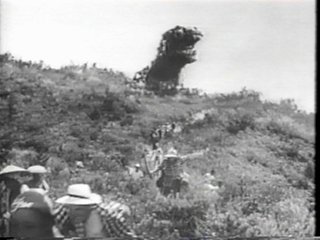
| It is
at the island where Godzilla makes his first on-screen appearance.
We see him briefly over the crest of a hill before he retreats back into
the sea.
From here on, the film follows what will
again seem like a familiar route (it's been 47 years since it was made
after all), with Godzilla making appearances in the city, leaving
flames, destruction and mayhem in his wake. |
 |
The big difference in this film is in
the way Godzilla's forays are depicted. We see the victims being
treated in the hospital for burns not unlike those inflicted by the atomic
bomb. The mourning song, by the assembled chorus at a girls school, wafts
over the soundtrack as we see and hear the reports of the toll this uninvited
guest has exacted.
Naturally, the general populace and
the military want to see him destroyed whereas Dr. Yamane knows that the
creature is just acting on his own instincts. He would rather see Godzilla
studied than summarily dispatched, but he reluctantly goes along as it is clear
that coexistence is not a likely option.
The other main element to this story
is the love triangle among Dr. Yamane's daughter Emiko, the youthful shipping
company agent Ogata, and the reclusive scientist Dr. Serizawa.
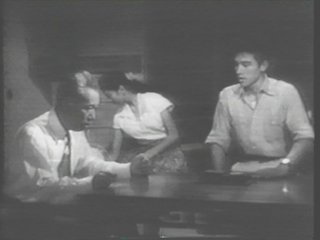
Dr. Yamane, Emiko and Ogata
debate Godzilla's fate. Dr. Yamane's disagreement with Ogata
threatens the future of Ogata and Emiko's as yet secret love. |
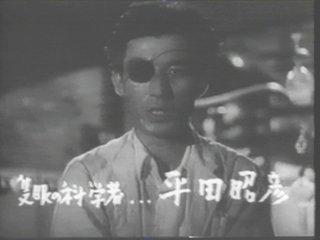
Dr. Serizawa. He and Emiko
have known each other all their lives and are promised to marry.
Serizawa holds the key to Godzilla's destruction. Will he use it? |
Though promised to Dr. Serizawa, Emiko has
developed a love for Ogata which has been kept secret. Ogata, looking for
the right time to approach her father on the topic, nearly blows it given his
differing views with Dr. Yamane on Godzilla's future. Dr. Serizawa reveals
to Emiko the subject of his research, the oxygen destroyer, and swears her to
secrecy. The oxygen destroyer does just that, at a molecular level, and in
his demonstration, Serizawa turns a tank full of fish into mere bones by
breaking down the oxygen in their cells. Emiko is horrified, and realizes
that she is now burdened with the knowledge that her fiancé's invention can
bring down Godzilla. To make this known to others would mean the betrayal
of her pledge.
Ultimately, she does just that, to Ogata, who
battles with Serizawa over the invention. Dr. Serizawa is fearful of what
mankind would do with such a weapon, having witnessed the destructive forces of
the bomb. He is won over by the realization that without the oxygen
destroyer the carnage will only continue, but he resolves to destroy all of his
records and himself in the process. His sacrifice is all the more poignant
as he also knows that he is giving over Emiko to Ogata as well.
I believe Godzilla succeeds then as now because it
was evocative of the true despair that massive death and destruction can
inflict, as well as the spirit of survival that can ensue. Made, as it
was, not long after the second world war, the people of Japan reacted to the
film on a very emotional level. Even in the American release, which was
hugely successful, the public must have responded to the themes of the film and
the mood it reflected. This was simply not just another monster film.
Godzilla 2000
I regret that I did not take the opportunity to
write my thoughts on this film sooner, as I saw it in the theatre some time
ago. It has recently been released on video. I have yet to re-watch
the film and these comments may seem trite as they are based solely on my
distant recollections.
First, I should establish that I am a fan of
Godzilla, if that is not already apparent. My collection is relatively
small yet boasts the original film Godzilla (Gojira) in bootleg form, as well as
Godzilla King of the Monsters, King Kong versus Godzilla, Destroy All
Monstors,
Godzilla's Revenge (All Monsters Attack), Godzilla versus
Mechagodzilla,
Godzilla versus King Ghidora (bootleg), and the disastrous Hollywood version,
Godzilla.
I saw Godzilla 2000 with much anticipation as it
had been reviewed well, and I have to agree that this film, at times, is
evocative of the original more that any since the first two Godzilla films came
on the scene in the mid-1950's.
I feel that the film falls short in several major
ways. First, in the transition from the alien ship to the giant monster,
clearly there are processes occurring that defy not only reality, but also the
reality in which we must place ourselves to believe the premise of Godzilla to
begin with. Nearly every film that is made fashions its own reality and
upon scrutiny we can identify many flaws where that reality seems to break
down. Obviously, films such as the Godzilla series, require us to suspend
belief to a large degree, and accept an alternate reality in which 100 meter
high creatures can stomp around, breathe fire, etc. The films can rarely
withstand close quarter inspection and the type of nitpicking that we fall into
when we are watching the movie for the twelfth time. However, I ask that
the weaknesses not present themselves so blatantly upon first viewing. As
you watch this transformation take place, you find yourself saying, unh unh, no
way. (Don't get me started on the Hollywood version which allows for a
monster that can run 70 miles per hour and destroy three of the best military
attack helicopters money can buy. Yet, it seems inexplicably unable to
overtake a broken down New York cab, with four passengers, lumbering through
streets littered with debris.)
Secondly, Godzilla is involved in a great deal of
destruction yet we see none of how this is manifest in human toll. The
starkness of the first film is dramatically underscored by the face of human
suffering that it presents. No, I don't want kids going to bed and having
nightmares after a Saturday afternoon matinee, but unless these films show the
dark aftermath of a visit from Godzilla, they will ultimately be just for kids.
Third, we are pulled in to rooting for Godzilla as
the ultimate protector of the human race against alien invaders. Given the
role that mankind has played in Godzilla's birth, and his many interactions with
the species, I'm thinking the only protection he affords us is that of a
carnivore fiercely defending its hunting grounds.
Lastly, at the film's end, Godzilla has a score to
settle with one particular human. This individual has been responsible for
ignoring the role Godzilla might have played in preventing the carnage wreaked
by the aliens, and treating Godzilla as a hostile, ordering attacks against
him. Somehow, Godzilla perceives this and spies the individual, making his
way (as only Godzilla can) through the city to confront and destroy this single
man. He does so without any others receiving a single scratch despite the
fact that he is approximately 100 meters tall and there are people standing in
close proximity to his victim. Perhaps the title should have been:
Godzilla, this time it's Personal.
All these complaints notwithstanding, I think that
Godzilla 2000 stands out as an admirable entry into the field. For me, the
standout moment comes during one of the battle scenes where Godzilla strides to
meet his opponent and the soundtrack underscores the gravity with the theme
music that appeared in the very first film. For me, this tie to the
original was evocative of the mood of the earlier film and legitimized this
movie in large part.
I did see the film on a Saturday afternoon in a
near-empty theatre. The few others in the house were pockets that included
typically one parent and one or more small children. I was favored by the
presence of a haggard mother and her two ill-behaved young sons. Besides
being an annoyance and a distraction, they also illustrate that this is indeed
the target audience of Godzilla films nowadays and maybe I am just a big kid
after all.
3-3-2001